RESIDENTIAL & COMMERCIAL · NORTHERN KENTUCKY
CONCRETE SLABS & PADS IN NORTHERN KENTUCKY
Spencer’s Outdoor Solutions pours shed pads, hot-tub pads, AC unit pads, equipment pads, shop slabs, and large industrial flatwork across Grant, Boone, Kenton, and Campbell counties. Rebar-reinforced 4000 PSI air-entrained concrete on a compacted #57 limestone base. Pour sizes from small 4×4 pads to slabs over 60 cubic yards.
WHAT SPENCER'S POURS
How Thick Should a Concrete Slab Be for a Garage?
SHED PADS, HOT-TUB PADS, SHOP SLABS, AND EQUIPMENT PADS
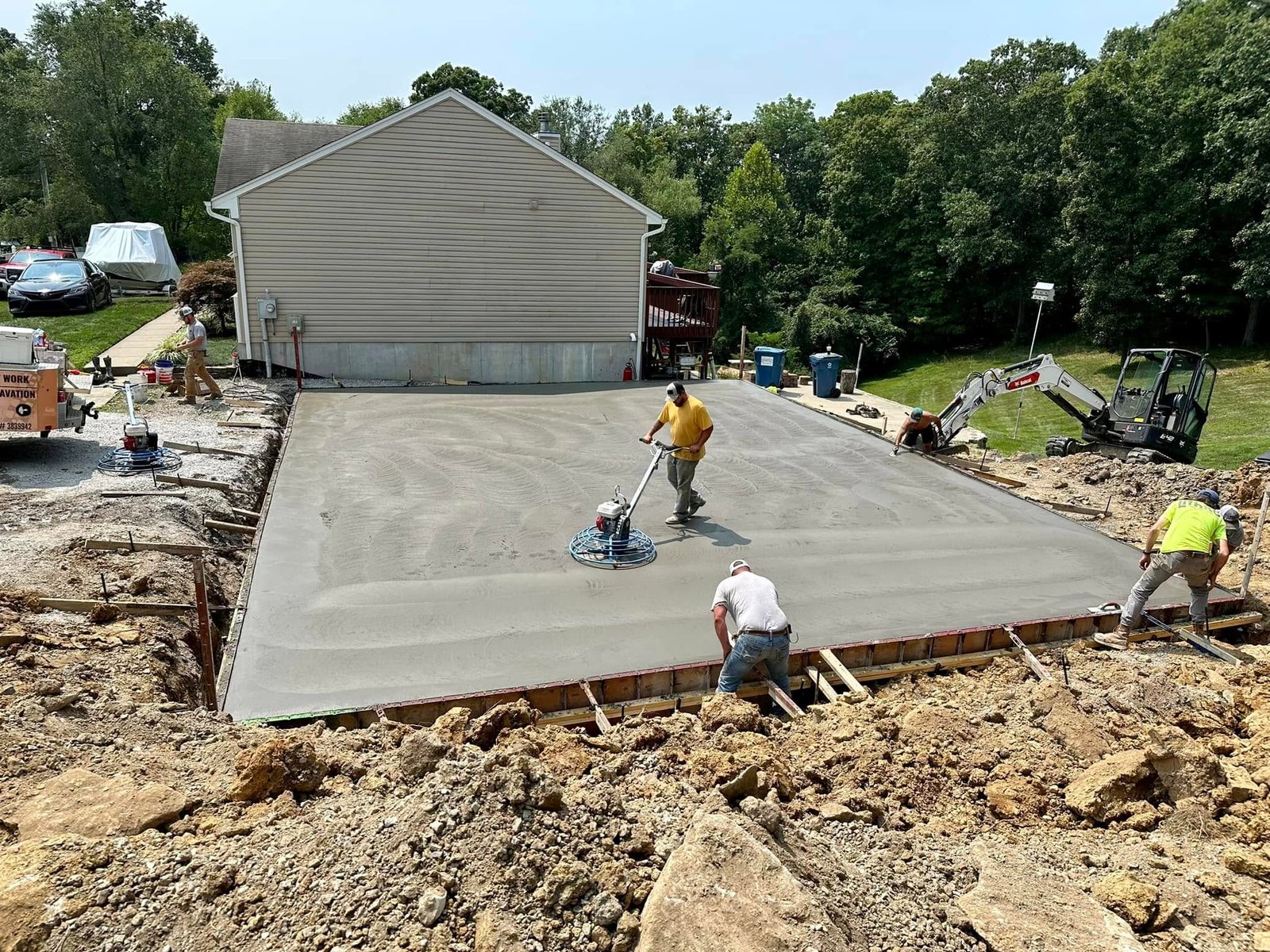
Slab and pad work is the bread-and-butter category of concrete. Shed pads, hot-tub pads, AC condenser pads, generator pads, propane tank pads, and shop floor slabs all use the same workflow: compacted subgrade, #57 limestone base, rebar tied to a grid, 4000 PSI air-entrained concrete, and a finish that matches the use case.
Standard residential pads pour at 4 inches with #4 rebar at 16-inch spacing. Heavy loads (hot tubs, sheds with stored equipment, RV pads) go to 6 inches with #4 rebar at 12-inch spacing and a thicker base. Spencer’s pours pads as small as 4 feet by 4 feet and slabs over 60 cubic yards in a single pour. Customers in Walton, Florence, Williamstown, and Dry Ridge all see the same prep and finishing standards.
- Shed pads, garage pads, and accessory structure slabs
- Hot-tub pads (6-inch reinforced)
- AC condenser, generator, and propane tank pads
- Shop floors and barn slabs
- Commercial equipment pads and industrial flatwork
- Large slab pours over 60 cubic yards in a single day
WHERE SPENCER'S WORKS
NORTHERN KENTUCKY, ROOTED IN GRANT & BOONE COUNTIES
Concrete work runs from the Dry Ridge yard outward — covering Grant County in full, the I-75 belt south of Cincinnati, and the river cities on the Kentucky side. Spencer keeps the schedule tight because the yard is central to every job within a 35-mile drive.
FREQUENTLY ASKED
CONCRETE SLAB & PAD QUESTIONS
How thick should a shed pad be?
What about a hot tub pad?
Does the slab need rebar?
How big a slab can Spencer's pour in one day?
Can a slab be poured against an existing structure?
How long until I can use a new pad?
QUOTE A SLAB OR PAD
Send the property address and pad dimensions. Spencer returns a free estimate within 24 hours.